
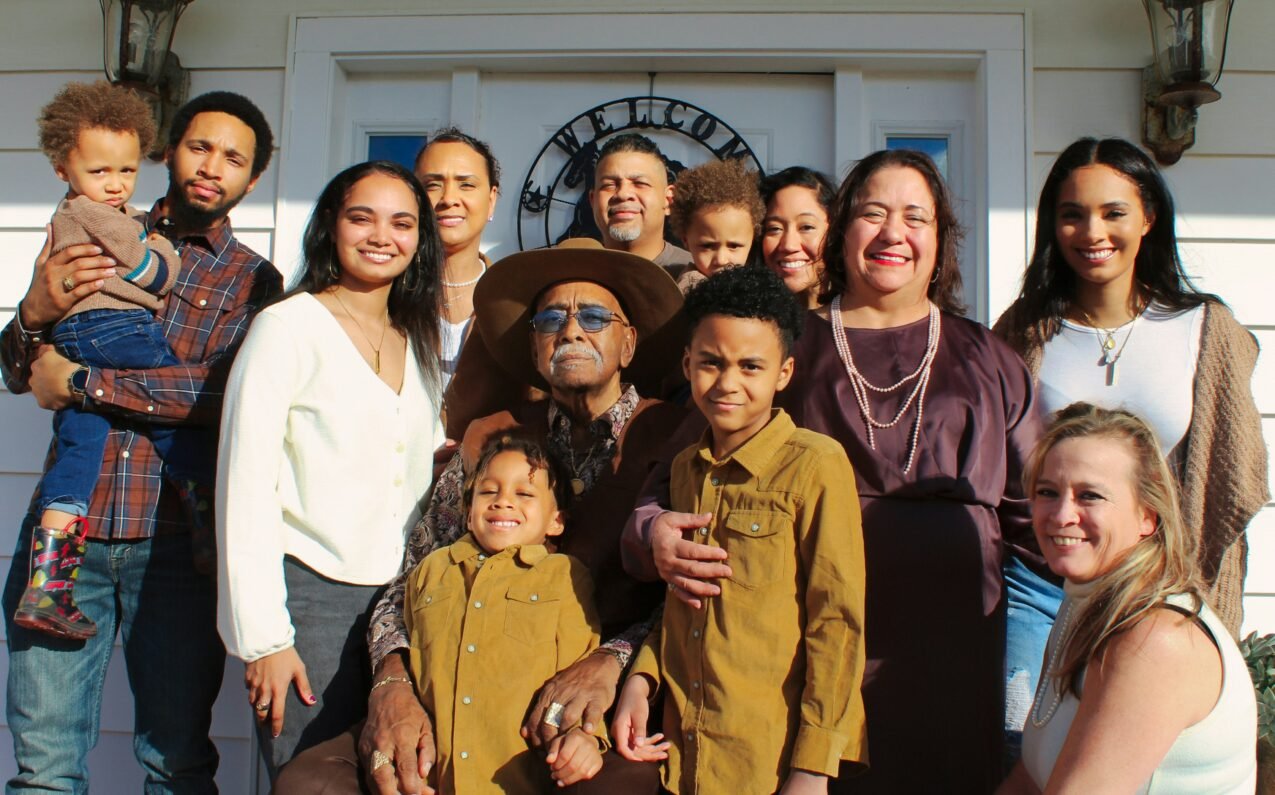
I remember being in kindergarten and becoming best friends with the other Afrolatina in the class, Dayana, we didn’t know why then but we knew our otherness made us stand out in a moment when all we wanted was to belong. We knew that we found in each other the belonging we often felt denied to us from friends and sometimes family. To my Costa Rican family I was the Panamanian cousin, to my Panamanian ones the Costa Rican kid. I remember calling myself a “Panatico,” a way to make all of me fit under one label. By the time I was ten, I’d learned that being both meant constantly proving I was either, and never quite succeeding at convincing anyone I could be all.
The questions always came with a certain tone. But where are you really from? As if my presence required an explanation. What are you mixed with? As if I needed decoding. The subtext was always clear: you don’t fit, so help us make sense of you. Tell us which box to put you in so we can stop being uncomfortable.
I learned early that the world wanted me to choose a box to fit into. As if identity were a single-choice exam and selecting “all of the above” would invalidate the test. But I have always been “all of the above.” Afrolatino. Afroindigenous. A nepantlero from the start, living in the borderlands not because I wandered there, but because I was born there. This would become central to my story but we’ll save that for another blog.
Gloria Anzaldúa taught us that nepantla is the space in-between, the place of transformation where those of us who live at the intersections become fluent in multiple worlds. But she also taught us that this fluency comes at a cost. The constant translation. The code-switching. The exhaustion of existing in a world that demands you fragment yourself to make others comfortable.
This essay is not about choosing. It’s about refusing to. It’s about what reclaiming all of your parts teaches us about belonging, not in spite of complexity, but because of it. And it’s about why the erasure of these identities isn’t accidental. It’s structural. It’s inherited. And why it’s important we named it.
What We’re Talking About When We Say Afrolatino, Afroindigenous
Let me name what should be obvious but somehow still needs to be said: Afrolatinidad is not a trend. It is not a hashtag that emerged in 2020. It is lineage. It is the story of more than 12 million Africans forcibly taken across the Middle Passage during the transatlantic slave trade, and here’s what they don’t teach us: only about 400,000 of them ended up in what is now the United States. The rest, the vast majority, were dispersed throughout Latin America and the Caribbean. Brazil alone received nearly 5 million. Cuba, Colombia, Venezuela, the Dominican Republic, Puerto Rico, Panama, Mexico. Every corner of the Americas bears the imprint of African survival and resistance. In Panama, where my mother’s family is from, Afro-descendant communities make up nearly 15% of the population, many of us carrying both African and Indigenous bloodlines that have been intertwined for generations. Afrolatinidad is not niche. It is millions of us who have always existed but were taught to stay quiet about the African in our blood and the Indigenous in our history.
To be Afrolatino is to carry the legacy of the African diaspora within Latin America and the Caribbean. To be Black and Latino, yes, but more than that: to be both at once, inseparably. This is why I no longer hyphenate. Why I write it as one smooth word: Afrolatino. Afroindigenous. The hyphen suggests separation. But I am not one and then the other. I am not holding two identities in each hand, trying to keep them from touching. I am one thing. One word. Because my Blackness and my Latinidad don’t live in different rooms. They exist in the same body, the same breath, the same story.
Growing up in Costa Rica, where more than 80% of the population identifies as white or mestizo, I was often introduced as “el hijo de la panameña.” The son of the Panamanian woman. It was said like an explanation. A way to account for the color of my skin or the curls in my head without having to name Blackness directly. As if my mother’s country of origin was the polite way to acknowledge what everyone could see. This is the same country where, until 1948, Black people were legally restricted from living in certain parts of the nation, confined primarily to the Caribbean coast of Limón. It took a constitutional reform to grant AfroCosta Ricans full citizenship and the right to move freely within their own country. I learned early that Blackness in Latin America is often spoken in code, acknowledged through geography rather than named outright, erased through policy and reinforced through silence. A reminder that systemic racism and colorism doesn’t only come from outside our communities. It lives within them too.
To be Afrolatino means your ancestors survived the Middle Passage, survived colonization, survived the plantation, and still passed down language, music, food, resistance, and medicine. It means knowing that anti-Blackness didn’t stop at the U.S. border. It shaped every corner of the Americas, including the one I come from.
To be Afroindigenous is to hold another thread that colonialism tried to sever: the Indigenous roots that connect us to land, to ceremony, to ways of knowing that predate the violence of conquest. For me, that thread runs through my mother’s side. Through Panama, through ancestors who were both brought to this land in chains and those who were already there, stewarding the land long before borders were drawn. Naming this is to recognize that African and Indigenous peoples didn’t just coexist in the Americas. We built family, we built community, we built survival strategies together. Our bloodlines are evidence of resilience, not tragedy. Bloodlines that were almost erased by colonization. Our existence is a reminder they failed.
These terms, Afrolatino, Afroindigenous, are not boxes. They are identity and history. They unlock rooms we were told didn’t exist. They name what our families sometimes whispered and sometimes shouted and sometimes buried under silence because naming it was dangerous. They give language to those of us who have always known we were more than one thing, even when the world insisted we pick a box to fit in.
I carry both. Panamanian through my mother. Costa Rican through my father. Afrolatino. Afroindigenous. My Blackness is not diluted by my Latinidad. My Indigeneity is not erased by my African or Spanish ancestry. I am not half, or quarters of anything, even though for much of my youth I would try to explain my self away to others in fractions. Now I can recognize and say what I wish I always knew, I am whole. A walking resistance of narratives and colonial logic that says mixture is confusion or difficult to comprehend.
This is about reclaiming our histories and understanding what it means to be us. It is about learning who we’ve always been.
The Erasure Is Not Accidental
The erasure of Afrolatino and Afroindigenous identity is not an accident of history. It is the point. It is what colonialism was designed to do: fracture, hierarchize, and erase. Spain and Portugal didn’t just conquer land. They engineered a racial caste system meant to divide and control. The sistema de castas which created hierarchies. And at the top? Whiteness. Always whiteness. The message was clear: the closer you could get to white, the more human you were allowed to be.
This ideology didn’t disappear with independence. It evolved into mestizaje, the myth that Latin America had “mixed away” its racial problems, that we were all one blended people now, la raza cósmica, beyond Black and white. But mestizaje was never about equality. It was about absorption, imagining a future where Blackness and Indigeneity would be invisibile. This is blanqueamiento. The whitening. The implicit and explicit encouragement to marry lighter “para mejorar la raza.”
And it worked. Not because Blackness and Indigeneity disappeared, but because we learned not to name them. We learned that claiming African or Indigenous heritage was something you whispered, something you downplayed to make others comfortable.
The psychological toll of this erasure is real and it is deep. When you grow up being told that parts of you don’t exist, or worse, that they exist but should be hidden, you learn to fragment. You learn to code-switch not just in language but in self-presentation, in which stories you tell, in how much of yourself you allow to be visible. You learn hypervigilance, reading rooms to determine how Black you’re allowed to be, how Indigenous, how “ethnic” before it becomes a problem. You learn that wholeness is a luxury, and that survival sometimes means performing the version of yourself that makes others least uncomfortable.
I see this in my clinical work all the time. Clients who have never said the word “Black” out loud to describe themselves, even though their roots are from the diaspora. Clients who talk about family members who “look more Indigenous” as if it’s a separate category, not part of their own lineage. Clients who have spent their entire lives trying to be “not too much.” Not too ethnic, not too loud, not too present, because they learned that taking up space as their full selves was dangerous.
This is what erasure does. It doesn’t just remove you from the historical record. It removes you from yourself and your lineage.
What Claiming Wholeness Looks Like
So what does it look like to refuse the fragmentation? To claim wholeness in a world that has spent centuries telling us we’re too much of one thing and not enough of another?
It starts with naming. Not the polite euphemisms. Not the coded language. The actual words. Afrolatino. Afroindigenous. Black. Indigenous. Saying them out loud, in rooms where people would rather you didn’t. Saying them in Spanish and in English. Saying them to family members who flinch. Saying them until they stop feeling like confessions and start feeling like affirmations of who we are.
But naming is only the beginning. It also means conversations with elders, tracing your lineage, being willing to explore parts of your family history that maybe no one thinks are important. To claim wholeness is to claim your authentic self without apology, without explanation, without the exhausting performance of making others comfortable with your existence. Authenticity is the radical act of refusing to shrink, refusing to split, refusing to perform the version of you that makes colonialism win.
It means refusing the binary. Refusing to choose between Black and Latino as if they are opposing teams. Refusing to rank your identities, to decide which one is “more” you, to split yourself into fractions that add up to less than whole. It means understanding that you are not a math problem. You are not a percentage. You are all of it, all at once, and the contradiction is not yours to resolve. It’s theirs. Authenticity means letting the complexity exist without needing to flatten it, defend it, or justify it.
It means finding your people. Not just any people, but the ones who don’t need you to explain. Community isn’t optional when you live in the borderlands. It’s survival. And it’s also joy. It’s the space where you get to be whole without translation. It’s learning to welcome others who are also struggling through their own belonging. Eventually learning that we all deserve to be whole and that we are better when we are able to embrace diversity and complexity for all it’s beauty.
It means learning your history. The one where African and Indigenous peoples built networks of resistance together. The one where your ancestors didn’t just survive. They strategized, they loved, they created, they refused. Knowing this history changes the story you tell about yourself and the way you can hear the story of others. We’re not a mistake. We’re the evidence that they tried to erase us and failed.
For me, claiming wholeness has meant doing my work. Not as someone who happens to be Afroindigenous but does psychology. As someone who does psychology because I am Afroindigenous. My lived experience is not separate from my expertise. It is foundational to it. I understand trauma and resilience differently because it is embodied, historical, and lived. I understand identity and belonging differently because I have spent my life negotiating what it means to belong. I understand know that feeling like we were from nowhere made us able to be from everywhere. Finding many homes with many people, learning that we had more in common than not. Also to be curious and be willing to hear the story before making assumptions.
Wholeness is not a destination. It’s a practice. It’s a daily act of resistance. It’s allowing yourself to take up space as all of who you are, unapologetically, authentically, fully. And it is reconnecting with your sacredness and the sacredness of others.
Why This Matters for All of Us
This is not just an identity conversation. This is a liberation conversation.
When we erase Afrolatino and Afroindigenous identities, we erase the evidence of survival and resistance that challenges colonialism itself. We erase the proof that people refused to be divided and built families anyway. We erase the models of what it looks like to hold complexity without needing it to resolve it.
And that erasure serves a purpose. It allows the myth of mestizaje to persist. It allows Latin America to claim it has “moved beyond” race while anti-Blackness and anti-Indigeneity continue to structure who gets access, who gets citizenship, who gets to be fully seen. It allows the United States to treat “Latino” as if it were a race, flattening the reality that we are Black, we are Indigenous, we are white, we are Asian, we are all of it, and so much more. It allows everyone to avoid the harder truth: that white supremacy didn’t stop at borders, and that our communities are not exempt from it.
For non-Black Latinx folks, this is your work too. It is not enough to claim solidarity with Black and Indigenous movements while refusing to see the Blackness or Indigeneity within your own families, your own communities, your own mirrors. It is not enough to perform allyship while staying silent when your relatives make comments about “mejorar la raza” or when conversations about politics are avoided but harmful rhetoric and racism are not. Anti-Blackness lives in our homes. It is taught at our tables. And if we do not name it, if we do not interrupt it, we are complicit in its continuation.
For white folks engaging with Latin American communities, this is about understanding that “Latino” is not a monolith and it is not a buffer. When you erase diversity and complexity, you are participating in the same project of anti-Blackness that structures our society.
For those of us who are Afrolatino or Afroindigenous, living in these borderlands, this is about knowing that our existence is not a problem to be solved. It is a gift. It is resistance. It is what makes us, us.
Closing Thoughts
I think about that younger version of me, the little boy that just wanted to belong. The one who learned to fragment himself to fit into other people’s boxes. I wish I could go back and tell him: You are not the problem. The boxes are.
I think about my mother, carrying Panama in her body, in her voice, in the way she moves through the world and how it marked her experience. I think about the ancestors I will never meet but who I carry with me. The ones who survived the Middle Passage, the ones who stewarded the land long before it had these names, the ones who refused erasure and passed that refusal down to me.
I am Afrolatino. I am Afroindigenous. I am Panamanian and Costa Rican. I am whole.
And if you are reading this and seeing yourself in these words, if you have spent your life being told you are too much and not enough, if you have been made to choose, if you have been erased or explained away, I want you to know: You are not alone. You are not a mistake. You are not required to resolve the contradictions that colonialism created.
You are whole. You have always been whole.
And that wholeness? That is where the healing begins.
Other Afrolatino Psychologists and Authors:
- Dr. Hector Y. Adames – Afrodominican psychologist, multicultural psychology, Latinx mental health, co-author of Decolonial Psychology: Toward Anticolonial Theories, Research, Training, and Practice
- Dr. Mariel Buqué – Afrodominicana psychologist, intergenerational trauma, author of Break the Cycle
- Dr. Jennifer Mullan (@drmullanpsyd) – Afropanamanian psychologist, anti-racist clinical practice, Author of Decolonizing Therapy.
- Dr. Tanya Katerí Hernández – Afrocuban legal scholar, Racial Innocence: Unmasking Latino Anti-Black Bias
- Dr. Ariana Ochoa Camacho – Afrocolombiana scholar, decolonial feminism
- Dr. Yvette Modestin – Afropanamanian historian, Black Latin American history